



In Europe’s fast-evolving utility-scale battery market, speed matters. Accelerating equipment deliveries and construction timelines can have a significant impact on project returns, especially as developers race to bring capacity online.
Turkish BESS manufacturer Maxxen is looking to capitalize on this urgency. With production on Europe’s doorstep, overland delivery routes, and potentially simpler import logistics, the company is positioning itself to serve the continent’s rapidly expanding battery markets.
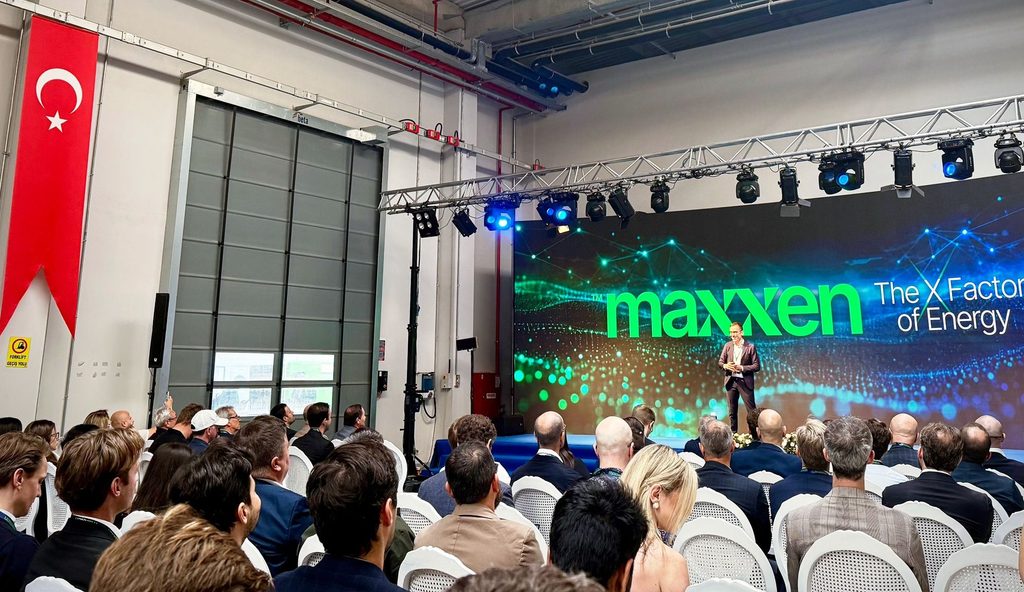
In what one attendee described as an exercise in “true supplier transparency,” Maxxen opened the doors of its new 5 GWh production facility in Aydın, Türkiye, to project developers, service providers, and the media last month. Bright blue skies greeted the roughly 600 attendees, who gathered in the factory’s loading bays and warehousing spaces for presentations, panel discussions, and canapés, while production continued on the assembly lines.
The Aydın region, south of Türkiye’s third-largest city, İzmir, is better known for its stunning Aegean coastline and all-inclusive resorts than high-tech manufacturing. Ancient ruins, fruit-laden fig trees, and picturesque towns are more familiar sights.
Yet in a dusty industrial precinct, Maxxen’s gleaming new facility offers a glimpse of the local transformation being driven by renewable energy and the batteries needed to support widespread electrification. With energy security again in sharp focus – and gas, diesel, and electricity prices remaining stubbornly high on the back of the ongoing conflict in the Middle East – the case for accelerating the energy transition has never been stronger.
Manufacturing matters
At the October event, Maxxen announced that it had shipped 644 MWh of utility-scale BESS to 21 projects in its first nine months of operations – an indication that the company is wasting no time establishing itself in the market.
The factory was inaugurated in December 2025 and was equipped in less than a year. Its production infrastructure includes a clean room for battery testing, KUKA robotic arms for handling, laser welding stations, and a system testing station capable of operating under full functional load.
(For an excellent overview of the production process, see Tristan Rayer’s detailed coverage in ESS News.)
“We are probably the fastest growing BESS manufacturing that has ever existed in Europe,” said Maxxen Managing Director Ruben Valiente, who had himself already been put through almost a dozen interviews during the event with different energy trade journalists from across the continent. “So, that is already in itself telling.”
Following its rapid emergence, Maxxen claims to have captured a 5% share of Europe’s utility-scale BESS market. The facility is currently operating at an annualized throughput of 1.5 GWh on a single shift. Adding two further shifts could lift production to its stated 5 GWh capacity, while a planned transition to higher-capacity battery cells in 2027 promises to further increase output.
“Our production is right-sized for European demand,” said Valiente.
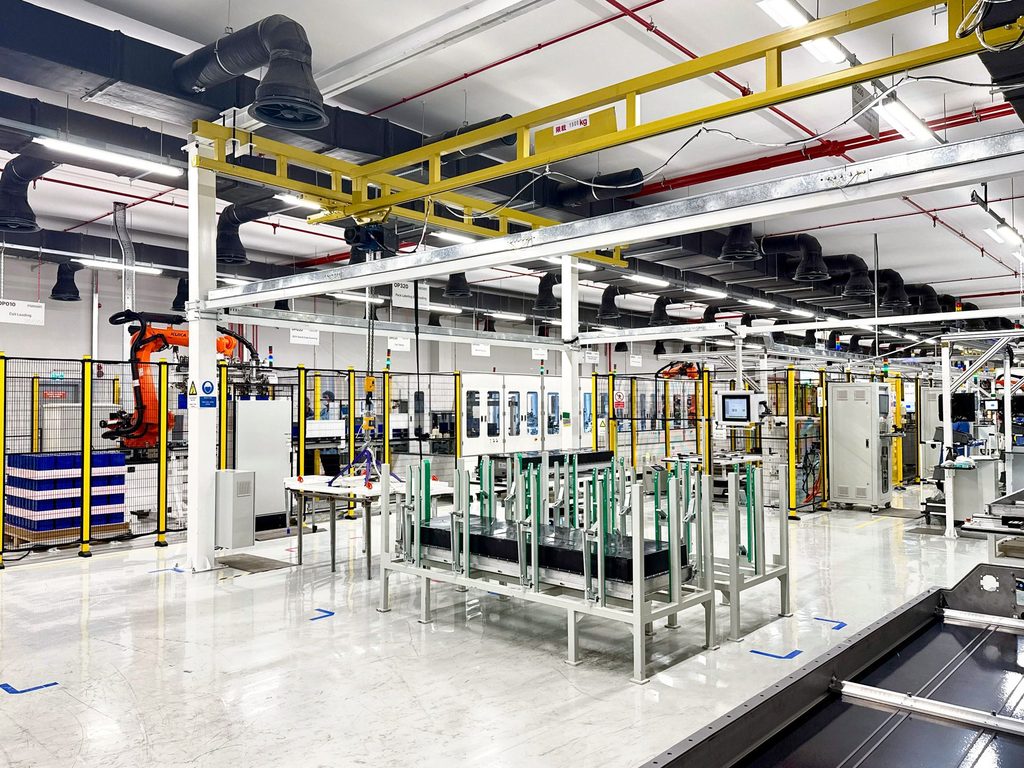
For now, Maxxen is shipping its containerized utility-scale BESS product, the 5 MWh DC Box. The technology inside is licensed from Chinese battery giant Hithium, which uses this model to support battery system assembly outside China.
Hithium’s presence was hard to miss at the event. Alongside Maxxen’s own branding, the Chinese company’s flag fluttered in the warm early October breeze as tour groups made their way through the production floor.
Reflecting growing demand for integrated utility-scale storage solutions, Maxxen also offers a medium-voltage power conversion skid, its MV Box, alongside the DC Box. Available in 2.5 MW, 5 MW, and 10 MW configurations, it is “a hell of a compact solution,” quipped Valiente.
But beyond the licensed battery technology, Türkiye’s established industrial supply chains provide another advantage.
“Türkiye has a big industrial capacity,” said Pablo Muñoz, Maxxen’s Business Development Director. “For us, the fact of being able to get local supplies of transformers, inverters, switch gear, and so on, gives us a lot of flexibility to react quickly.”
That flexibility could prove valuable as European developers look to shorten procurement timelines and reduce exposure to long-distance shipping and supply-chain disruptions.
A market on the doorstep
While European demand is central to Maxxen’s ambitions, the company’s home market presents a substantial opportunity of its own.
The Turkish BESS market itself is an attractive one. “It’s big, obviously,” said Muñoz. “So, the local demand can be covered directly by us. And it is a bit protected with the local taxes, so that is supporting local companies.”
Unlike the European Union, the Turkish government has provided protection to its local clean energy manufacturers – although changes to both tariff and domestic-content rules has spurred periods of both rapid expansion and consolidation in the past. With more than 25 GW of solar installed to date, and 2 GW in the first half of 2026, there has proven to be sufficient domestic and export demand to support a small group of solar manufacturers, with the largest three – CW, Smart Energy, and Schmid Penkitas – adding solar cell capacity to their module assembly. China’s Chint Astroenergy also produces in Türkiye.
Looking to BESS, a pipeline of 33 GW of utility-scale batteries has received government pre-approval, and with 2024 reforms to its Renewable Energy Resource Zone tender program, known as YEKA, successful projects can now add battery capacity rated to the renewable energy asset. These batteries can then participate in energy arbitrage, ancillary services, and potentially other markets as energy-market reform continues.
With the opportunities clear, it is not a stretch to see Maxxen continuing to supply European marketplaces – given its ability to move fast. Istanbul-based Reap Battery is pursuing similar plans and was formed by a joint venture of local company YEO Technology and Chinese battery and EV giant BYD.
“It makes sense to nearshore in Europe, or close to Europe,” concludes Valiente. “In this case Türkiye is a very good option, with cost competitiveness and the distance to the different markets. We are in the right place.”
More from Maxxen Day 2026
Check out our full report from the event below and follow Climate Copy on Youtube.


