


With its rapid increase in conversion efficiency, perovskite PV cells and modules have emerged as the most-likely candidate for next-generation solar technology. But it’s far from inevitable. There remains a number of significant hurdles that must be overcome for commercialization.
In a recent post on LinkedIn, Peter Pasmans at Eternal Sun dubbed “efficiency, stability, and scalability” as the “perovskite trinity,” an apt descriptor for the sort of Holy Grail for the photovoltaic technology type that’s been a year away from being a year away from a mainstream PV takeover. Or maybe three years away, to be more fair.
Nonetheless, as Pasmans notes, PV perovskite devices and the production processes required must simultaneously become competitive with incumbent crystalline-silicon technologies on all three fronts. On the efficiency and scalability fronts, reaching scale production remains challenging but evidence suggests great hopes. Device stability remains the nut to crack, though even in this area, progress continues, as evidenced by several impressive results.
And, Oxford PV signed two licensing agreements in the past year – one in the US, just in the past weeks – which sends a clear message that the world's leading solar manufacturers, both East and West, are taking perovskite IP seriously.
In April 2025, Oxford PV and Trinasolar signed an exclusive patent licensing agreement covering the manufacture and sale of perovskite-based PV products in the Chinese market, including a right to sublicense. China's domestic PV market is valued at over $50 billion annually and projections go anywhere up to double or more by 2030. Trinasolar's Chairman and CEO Gao Jifan described it as the start of "a new era of industrialization for perovskite tandem technology."
More recently, in late February 2026, Oxford PV signed a further non-exclusive patent licensing agreement with First Solar, the largest solar manufacturer in the Western Hemisphere and the world's biggest producer of thin-film solar modules.
The agreement as published gives First Solar access to Oxford PV's issued and pending patent portfolio for perovskite technology, covering potential manufacturing and distribution across all US market segments from utility-scale to residential.
One of the most critical aspects here is that First Solar is going for a thin-film perovskite route, not a tandem-on-silicon one, as silicon-based semiconductors weren’t part of the team.
First Solar has said it has invested over $2 billion in thin-film R&D, including a perovskite development line at its Perrysburg, Ohio campus already producing small form-factor modules. CEO Mark Widmar said the agreement "reflects the confidence we have in our R&D team's progress in developing an efficient, stable, and manufacturable perovskite device."
Evidence of progress
Can perovskites hold up to the rigours of the real world? We go back to PerovskiteConnect in Berlin held in late 2025. The Oxford PV licensing deals are best understood against that backdrop.
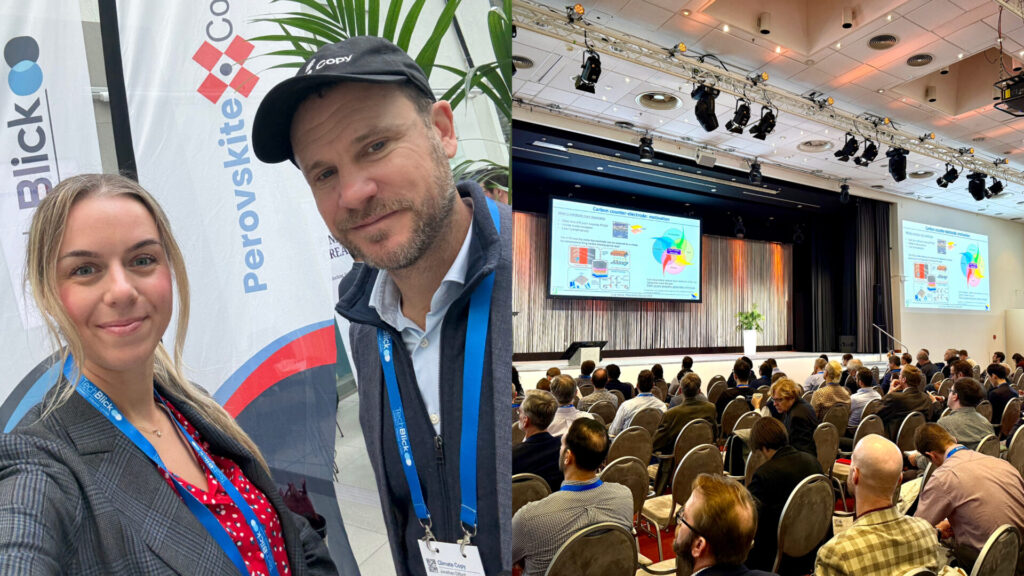
Across presentations from developers, researchers, and manufacturers, those three parts of the perovskite trinity were on display.
Progress on efficiency has been impressive: CubicPV's 24% single-junction mini-module achieved using serial production techniques was a standout result from the event.
Scalability, too, is beginning to look less daunting, with a collaborative 22.2% efficiency, 30x30 cm mini-module produced using Sofab's tin-oxide nanoparticle inks and Alpha Precision Systems' slot-die coating tools showing what ecosystem collaboration can deliver.
Stability, historically the most stubborn, is also moving in the right direction: Oxford PV itself presented outdoor performance data for 2023-vintage modules, with a roadmap targeting 1% annual degradation at 27% efficiency by 2027, and 0.5% from 30% efficiency by 2030.
Microquanta, meanwhile, reported real-world outdoor results of just 1.7% first-year degradation, dropping to 0.5% in year two, and backed that up with a 12-year product warranty and a 25-year performance warranty on modules now deployed across more than 30 MW of projects, including an 8.6 MW agrivoltaic system in Songyang, China.
Real-world results will be decisive. In that light, an expansion of test perovskite arrays is encouraging. In 2025, the renowned solar research group at the UNSW School of Photovoltaic and Renewable Energy Engineering (SPREE) established its first outdoor perovskite test array. Climate Copy visited the first rooftop array with Scientia Professor (and PV-technology legend) Martin Green.
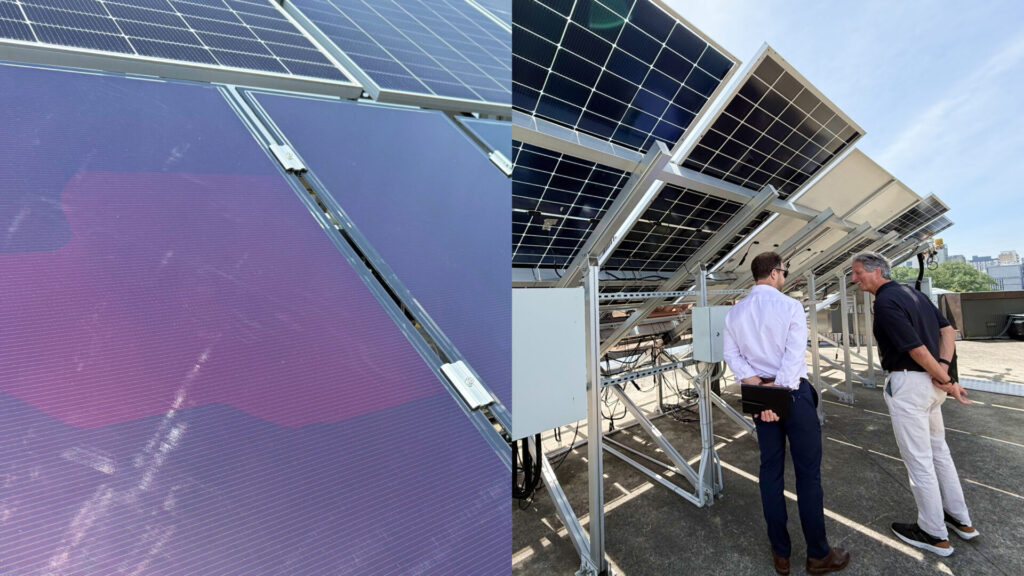
Interestingly, there were visible defects already apparent in at least one of the modules. “These are likely infant mortalities,” said Green – referring to potential faults in the lamination process. Perovskite semiconductors are vulnerable to both degradation UV and moisture ingress, making the encapsulation of perovskite modules particularly vital.
The UNSW test bed is promising as the Australian research institute has long enjoyed a close partnership with the Chinese industry. This should presumably result in Chinese perovskite developers being more open to providing their products for testing.
Germany’s Helmholtz-Zentrum Berlin für Materialien und Energie (HZB) is also operating an outdoor perovskite test facility. The program is already revealing insights into how dark and light cycles impact metastability and degradation – and even recovery during low-light periods.
The variable of trust
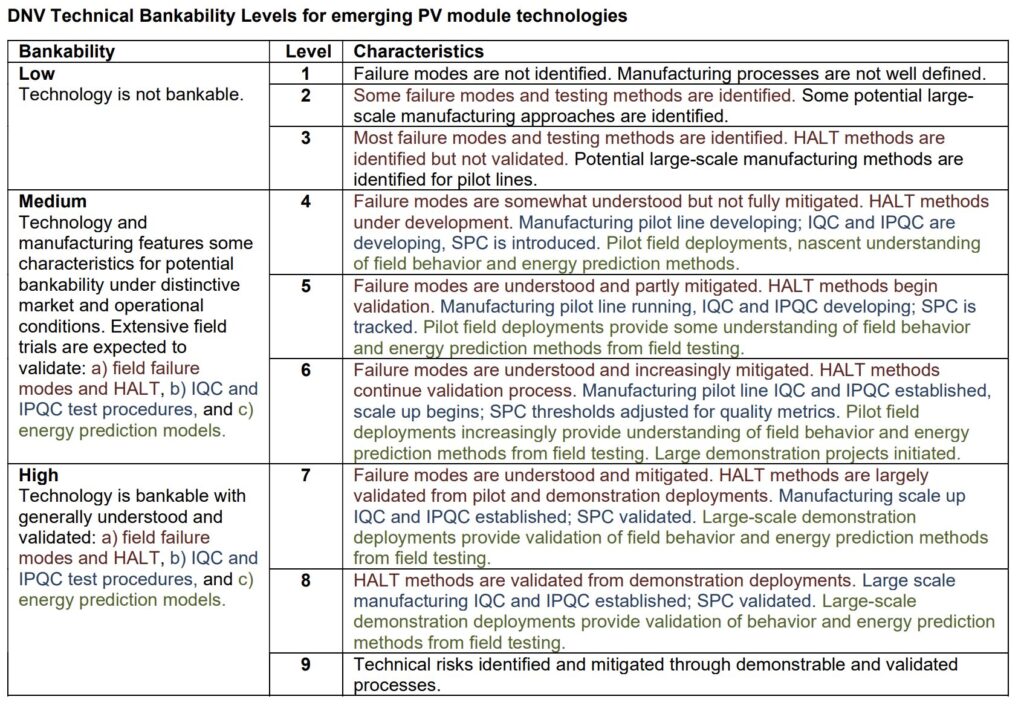
At PerovskiteConnect, TotalEnergies PV expert Lars Oberbeck offered a useful reality check through DNV's Technical Bankability Level rubric. Currently, single-junction perovskite technology sits at Level 6 out of 9 on the DNV scale that’s largely classified as ‘medium’ bankability, with failure modes being understood and increasingly mitigated, but falling short of maturity required for widespread conventional project deployment. Perovskite-silicon tandems sit at Level 5. Investor-grade trust still needs to be built, and the prescription on the day was for transparency and more sharing of accelerated and outdoor test data.
One bit of good news about data sharing came from the news of the Solar Technology Acceleration Program (Solar TAP), which brings together three Helmholtz bodies, the HZB, the Forschungszentrum Jülich, and the Karlsruhe Institute of Technology. The aim there is to accelerate the development of PV technologies including perovskites via collaboration, both sharing information and R&D equipment.
The Oxford PV licensing agreements, in their own way, contribute to a few points towards trust via the signal that serious players, money, and IP are being firmly committed to this technology's future.
In terms of reactions, the tone in trade media was bullish. Electrek described the First Solar agreement as a signal that the company "sees perovskites not as a side experiment, but as a core part of its long-term strategy."
At Climate Copy, we oscillate between being bullish and realistic – as we work closely with those invested in perovskites, but also hear voices that are skeptical as to whether the technology will remain unstable. UNSW’s Green, for one, believes that the reason such rapid progress has been made with boosting efficiency could also be why the material seems difficult to stabilize – and long-term performance has been one of the great virtues of the incumbent crystalline-silicon solar technology.
In any case, we’re monitoring the pace of change at close range. And it’s clear that the perovskite solar momentum is building.


